
I was introduced to sauna at four weeks old - my father’s idea.
He was a Finnish immigrant to Canada - a mechanical engineer by training and a sauna builder by passion. In our house, sauna wasn’t a novelty or a wellness accessory. It was simply part of life. You went to sauna the way you ate dinner or shoveled snow.
My father, however, was not a quiet Finn when it came to sauna. He loved talking about it - the stories, the culture, and especially the mechanics of it. Heat transfer dynamics. Airflow. Stone mass. He was forever sketching heater ideas and explaining why some designs produced better löyly than others.
He also wrote about sauna - essays and reflections that tried to capture something deeper about the practice. One of them carried the title Sauna Exists, Therefore I Am. It took me some time to fully understand what he meant. I only knew that sauna seemed to matter in a way that went beyond heat and steam.
On my mother’s side of the family, the tradition ran just as deep. My Mummo - my grandmother - had a lakeside sauna on Lake Superior in Thunder Bay, and many summers of my childhood were spent there: cold water that stole your breath, wood smoke drifting through the trees, and the quiet rhythm of sauna, swim, repeat.
Her sister - my great-aunt - founded Kangas Sauna in Thunder Bay in 1967. Eighteen saunas under one roof. Families, workers, neighbours. Steam rolling down the hallway and the smell of my Mummo’s Finnish pancakes drifting in from the adjoining restaurant where she worked.
Thunder Bay, after all, became home to one of the largest Finnish communities outside Finland, and sauna culture naturally followed. It remains a quiet epicentre of sauna life in North America, shaped by generations who carried their traditions across the Atlantic. For us kids, it was simply normal.
Looking back, I realize I was immersed in sauna culture long before I had the words to describe it.
Today my relationship with sauna has become professional as well as personal. I design saunas, consult on them, and help people build them in homes, hotels, and public spaces across North America. As an ambassador with the North American Sauna Society, I also spend time talking and writing about sauna culture itself - what it is, what it means, and why it continues to matter.
Which brings me to something I think about often.
Sauna is having a moment.
Across North America, new saunas are appearing everywhere - in backyards, on docks, in cities, and in forests. New communities are forming around them, and it’s exciting to see.
But it also raises a quiet question: if anything can be called a sauna, what is a sauna?
Finns have traditionally been very relaxed about these matters. Sauna has always taken many forms, and there are very few rigid rules – the only one that comes to mind is “Ovi kiinni!” That openness is part of the culture.
Yet there is also a subtle downside. Finns are not always quick to define, protect, or promote their traditions to the outside world. Sauna has been part of everyday life for so long that it hardly seems worth explaining.
The risk, of course, is that if you don’t define something, others eventually will.
Sometimes well.
Sometimes not.
For me, the essence of sauna is actually quite simple. Sauna is family, community, washing, and reflection. It is children and grandparents sharing the same bench. It is throwing water on hot stones and feeling the room come alive with löyly. It is sitting long enough for the noise of the outside world to soften.
Performance is not required. Perfection is not required. Just heat, steam, and time.
Sauna will continue to evolve as it spreads across North America - as living traditions do. That evolution is natural and welcome. But the centre should remain intact.
After all, I was introduced to sauna at four weeks old. My father knew something then that I have spent a lifetime coming to understand: sauna is not just something you build.
It is something you inherit - from family, from culture, or simply from the people who first invite you onto the bench.
From places like Thunder Bay. From family. From the quiet traditions that travel across oceans and generations.
And something you pass on - preferably sitting together on the bench, throwing water on hot stones, and watching the room fill with löyly.
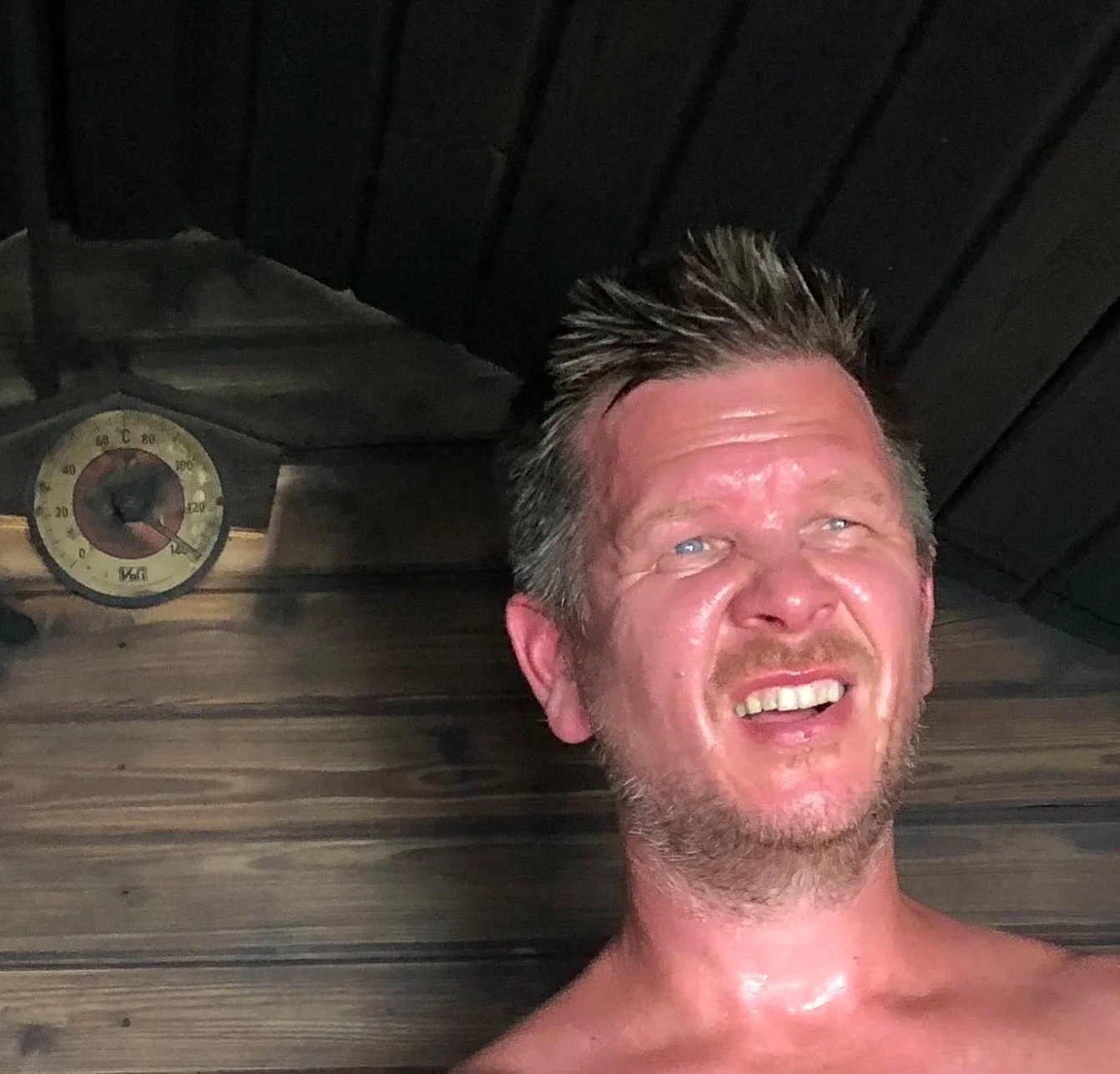
Mr. Sauna