Sauna and Sauna Bathing

Sauna and Sauna Bathing

Photo courtesy: Olli Kilpi, Kustavi Finland

NASS has embarked on a project to rate public saunas. The focus is on establishments that carry the name “sauna.” Most often, particularly here in the US, they are ancillary services at gyms, sports clubs, hotels, etc. The project has created a lot of discussion even at the basic level of how to define a sauna.

Hardcore sauna enthusiasts, such as the undersigned, have difficulties to understand how the word “sauna” is sometimes used so loosely in North America. We don’t even have to go as far as looking at all kinds of belly warmers, blankets or various closets (you name them) that carry that same name. 

Sauna sales are strong and many companies are seriously backordered. So, now that the market is hot, it’s a perfect time to make a point about North American sauna bathing. 

Personally, I have been sidelined for years by thinking that the quality of the sauna in North America is not on par with the rest of the sauna bathing world. This is not the case. While competition is often price driven, the product mostly matches with its intended use. In order to explain this, we need to define and separate the words “sauna” and “sauna bathing.” 

Sauna in North America is a generic name that includes many different types of thermal therapy. The most common ones are traditional saunas and infrared rooms. People often use saunas and infrared rooms in the same way; to warm up and slightly sweat either before or after a workout, with a one time stay and clocking, depending on the heat and other circumstances, anywhere between a couple of minutes to 20 - 30 minutes in the heated space. This, however, for sauna aficionados is not considered sauna bathing. Sauna bathing is a process that has elements also beyond the heated space. These are showers that are right next to the sauna, cold plunges, places to rest and perhaps also access to outdoors for rejuvenating between the visits to the hot room. Also, inside the hot room there are heaters meant for throwing water on the rocks, which is part of the authentic sauna bathing experience.

If your sauna is not used for sauna bathing, the good news is you don’t need to include the elements that otherwise would be needed, such as good working ventilation, drains, showers next to the sauna, etc. You can have a limited functioning heater, even a space heater can do. Building this type of “warm up space” saves money, but also compromises the most sought after aspects of sauna; proven health benefits and endorphin induced good feelings that the authentic sauna will bring you.

It is our utmost mission to make sure that all sauna using people would understand the difference. NASS is looking for organizations and locations that offer authentic sauna bathing services. We want to promote them on our website and through our social media exposure. The beauty is that thermal therapy is always good for you. The outstanding benefits come from the real deal, when it’s used like it’s supposed to. Compromises can be made, as long as we all know what these compromises are.

Eero Kilpi, Ph.D. President, NASS

Sauna and Health

Sauna and Health

Photo credit: KLAFS GmbH & Co

By Dr. Lasse Viinikka, medical doctor and former Chairman of the International Sauna Association and the Finnish Sauna Society

Copyright: Lasse Viinikka and Medical Health Library by Duodecim Publishing Ltd, terveyskirjasto.fi

(The original text is in Finnish and has been translated by the request of the North American Sauna Society by Eero Kilpi et al).

This article is informational in nature and is not a substitute for the professional medical judgment of treating physicians or other health care practitioners. This article is based on information available at the time and may not be updated with the most current information available at subsequent times. This article contains no warrant or guarantee, and the writer, publisher or the North American Sauna Society shall not be liable for any deficiencies in the information contained herein or for any inaccuracies or recommendations made by independent third parties from whom any of the information contained herein was obtained.

The original article, the translation of which the present article is, was written in Finnish for Finnish people, who are used to regular sauna baths from early childhood and thus know its effects well. Accordingly, all the conclusions or recommendations of the article may not be appropriate for persons, who have less experience with sauna. The orders and recommendations of local authorities should always override this article.

The conclusions of this article are the writers best attempt to summarize often scanty and contradictory scientific data. It is possible that another expert could have ended up with different conclusions from the same data.

Sauna’s Central Physiological Effects


Skin Temperature and Sweating

A Finnish sauna is the hottest place a person would enter voluntarily. Even inside the hot room, one’s body strives to maintain its normal temperature and greatly intensifies its heat exhaust system. A direct conclusion is big changes in one’s blood circulation system.

Skin heats up inside a sauna in just a couple of minutes to over 104º degrees Fahrenheit. At the same time, skin blood vessels dilate (vasodilation) and blood circulation increases. Signals of overall heat increase travel to the brain’s thermoregulation center (hypothalamus), which starts the process of removing the heat from the body. The autonomic nervous system starts the sweating process and blood vessels dilate further. Since one’s body surface is hotter than the inner body, increased blood circulation is not an effective way to exhaust the extra heat in a sauna.

Sweating is the most efficient way to exhaust excessive body heat. A Finnish style sauna is quite dry, so the sweat that has trickled to the skin’s surface vaporizes fast. Sweating quickly increases as the sauna bathing proceeds. At a latter part of a 15 minute sauna session, the heat extraction efficiency is 10 times more efficient than at the early minutes of the sauna session. At one traditional sauna visit (several sessions at the hot room), the amount of released sweat is 17 to 34 fluid ounces (0.5 to 1 liter).

Sweat salinity is only a third of the rest of the body’s fluid salinity, which means that pure water without extra salt is fine to drink at a sauna. When your body starts perspiring the skin temperature goes down a bit, but starts rising again if the sauna session is prolonged. A human body cannot retain stable body heat in the sauna; the temperature of the internal organs raise a bit, as well, for an adult a little over one degree Fahrenheit.

The core of sauna enjoyment is the feeling of warmth. This is conveyed through the skin’s heat receptors and increased by throwing water on the stove rocks (so called löyly). The temperature in the sauna doesn’t increase, rather the feeling of heat is created by the energy released by condensed steam. To convert 212ºF water to 212ºF steam takes five times the energy than heating 33ºF water to 212ºF. This is the amount of energy that is released when steam converts back to water on skin’s surface. It causes the hot, sometimes borderline painful, feeling. The droplets that surface on your skin soon after the “löyly” are not sweat, but the löyly steam that has condensed to water.

Changes in Blood Circulation

The dilation of the surface blood vessels cause considerable changes in one’s bloodstream. Inside a sauna, of the blood that is pumped by the heart about 50 to 70% goes to the surface vessels of the skin. In room temperature, this number is 5 to 10%. Abdomen and inner organ circulation comparatively diminishes.

The dilation of blood vessels diminishes blood’s flow resistance up to 40%, which eases the heart’s pumping task. Conversely, the heart rate increases, since it has to compensate for the blood pressure decrease caused by skin blood vessel dilatation. The need for increased pumping volume can be up to 75%.

The heart beat goes up in a sauna easily to over a hundred, with some, it can increase up to 150 bpm. The overall heart work load remains still quite low in comparison to the heart rate and is the equivalent of a brisk walk. Many people with mild heart conditions can therefore safely sauna bathe after consulting their doctors.

Sauna and Blood Pressure

Surface blood vessels will dilate in the sauna’s heat. It is shown by the reddened skin. The total volume of blood vessels increases, which would cause lowered blood pressure, if the heart did not increase its pumping power. During intensive sauna bathing, one’s heart rate can more than double. 

Sauna’s effect on blood pressure has been researched extensively. Results are partially contradictory, but most often it has been stated that sauna bathing causes blood pressure to decrease. A certain consensus seems to be that sauna decreases one’s blood pressure on average by 10 mmHg, or a little less. At its longest, this influence has carried on up to 24 hours. In most studies blood pressure has turned back to its pre-sauna levels much faster.

Individual differences are, however, quite substantial. Some people experience slightly elevated blood pressure in the sauna, for some it stays the same, and with the rest, it goes down, usually moderately, but in some cases tens of mmHgs. Too low blood pressure can cause weakness, nausea and even fainting. Considerable individual differences in one’s blood pressure fluctuation may be one way to explain why some people enjoy the hot room so much longer, while others don’t.

Sauna and Hypertension Outbreak (High Blood Pressure Condition)

A Research group at the University of Eastern Finland found an interesting correlation between sauna and blood pressure. In an epidemiological study it was found out that among the middle-aged men who sauna bathed 4 to 7 times a week, a chance of hypertension outbreak during the 20-year follow up was only a tad over half, compared to the risk with a reference group who only sauna bathed once a week. This notion is completely new. Even if the found statistical connection doesn’t show the cause and effect, this finding is an important building block for future research.

Sauna and Treatment of High Blood Pressure

Sauna diminishes both normal and elevated blood pressure the same way. Hence, sauna has sometimes been promoted as a way to non-medically treat high blood pressure. You could naturally consider it as a part of the changes in one’s lifestyle when trying to lower one’s slightly elevated blood pressure, before the actual medical treatment takes place. Sauna, however, cannot be the principal form of treatment. 

Those who take blood pressure medication, should be careful in a sauna. Beta blockers are commonly used to treat elevated blood pressure. They slow the acceleration of one’s heart beat, which may cause a detrimental drop in blood pressure. Preliminary considerations of the combined effects of blood pressure medication and sauna are hindered due to the fact that patients often take a mixture of different blood pressure medications at the same time. Combined outcome of taking multiple medications and experiencing heat is not well known. A high blood pressure patient who has started with new medication should be cautious at first while sauna bathing to find out how his/ her body reacts to heat and drug combinations. If a person has experienced symptoms of lowered blood pressure, it should be discussed with his/her physician once a renewed treatment plan is considered. 

Blackout in a Sauna

Even if the body is used to sauna’s excessive heat, there are also some dangers. One of them is abrupt fainting. If ambulances are called to public/ commercial sauna establishments, this can be the reason. Very often the patient is already conscious when first responders reach the destination.

Mechanisms of Passing Out

Fainting is normally caused by a body position dependent drop in blood pressure and thus a lack of oxygen to the brain. Blood vessels dilate in the sauna heat and blood packs to the lower body more than normal. Upper body and particularly head oxygen intake diminishes. This phenomenon is highlighted when one stands up after lying down or sitting down.

Normally the brain’s blood vessels pressure receptors send a message of danger to other body organs. In consequence, lower body vessels contract and there is once again enough blood for the brain’s needs. But in case this mechanism is not working well enough, the brain does not get enough oxygen and one passes out.

Dehydration caused by sweating makes things worse, as do several medications, including many blood pressure medications. The common detriment is body position dependent blood pressure decline. This body position dependent blood pressure “sag” can also effect younger people, but as one gets older the phenomenon becomes more prevalent. About a third of the 70+ population suffers from it.

Treatment and Prevention of Blackouts

Fainting in general is not very dangerous. After lying down, the brain again receives adequate quantities of blood, and the sauna bather gains consciousness within minutes. The situation cannot, however, be taken lightly and the fallen person has to be monitored thoroughly. Fainting can be a result of a condition that in itself, requires instant treatment. Falling can cause cuts, welts, bruises, broken bones or, at its worst, brain damage. 

Even an experienced sauna bather can be taken by surprise by unexpected fainting. Many have, however, warning signs before the incident. Tripping can be preceded by nausea, changes in one’s vision, dizziness, wiggly knees, or a feeling of being onboard of a ship going through waves. Most often the situation is at its worst a moment after leaving the hot room. If you experience these symptoms, sit down, or more preferably, lie down. If nothing else, go on the floor and don’t hesitate to ask for help.

There is no cure for the position dependent blood pressure drop. The only remedy for the sauna related excessive blood pressure sag is less sauna, in other words, less steam (löyly).   If you can lie down on the bench with your feet up, that helps, but standing up from that position is more demanding than standing up from a sitting position and could make things worse soon after sauna.

During a long sauna session, one has to remember to hydrate during breaks from the hot room. With any new medication, and particularly with new blood pressure medication, one should use caution to find out how the new medication and heat together influence one’s body. It is essential to talk to your doctor particularly after sensing symptoms of lowered blood pressure.

Sauna and Heart Failure

Heart failure develops when, for example, a heart attack damaged, or high blood pressure weakened heart doesn’t have the strength to pump an adequate amount of blood to one’s body. Heart impairment is a set of symptoms, rather than a single sickness. Its signs are being short of breath, fatigue even from a minor physical stress, and lower limb swelling.

Because sauna bathing increases the heart’s workload, one would think it’s bad for a person with a heart condition. However, there is also a different angle to this. Because of the dilated blood vessels, blood’s flow resistance diminishes in sauna, which eases the heart’s task to deliver blood to different parts of the body.

The balance between various pros and cons of sauna bathing for a patient with a heart condition has been studied many times. These studies have given some indications that sauna would ease heart failure symptoms. Yet, the number of patients being studied have been so small that reliable conclusions have been difficult to find.

Remarkable new information was achieved recently when an international cooperation project gathered all methodologically similar studies together, so that due to similarities in their empirical research structures, their findings could be handled as one entity. This approach is called a meta-analysis. Meta-analysis based result findings are often considered substantial. There were originally 1,444 studies, out of which only 7 made it to the final analysis. They had altogether almost 500 patients, whose illnesses were medium severe. These patients were submitted to a 15 minute 140ºF heat, created by infrared radiation. After the heat, patients could rest for 30 minutes under warm blankets. This treatment was repeated five days a week for four weeks.

Heat worked suitably for these heart failure patients. Their hearts diminished in size, the volume of blood pumped with one heart beat increased and heart based salinity hormone content, which reacts sensitively to heart failure, decreased in the blood stream.

It is unfortunate that these types of combined analyses have not been conducted regarding a Finnish sauna. The body heat raises in the above mentioned heat exposure about the same as at our own, traditional sauna, so one could think that with certain caution, one could apply these findings to the traditional sauna, as well.

The mechanism of symptom alleviation is not well known. It is understood that sauna lowers blood pressure, repairs the functioning of the insides of blood vessels, so called endothelial cells and lessens the stiffness of vessel linings. All these occurrences might ease up the workload of a weary heart.

Even if sauna would seem to bring relief to a mid severe heart failure, people suffering of this condition should still be careful. Because it’s always a serious malady, its treatment is only carried out by consulting one’s physician, who also should consider the pros and cons of sauna bathing in general.

Sauna and Heart Attack

In 1976 Colonel Foster asked in a letter published in one of the world’s most highly regarded medical journals whether the high rate of deaths by heart attack in Finland could have had something to do with sauna bathing. His assumption was based on the fact that there were a lot of deaths by heart attack and very many saunas in Finland.

It is not known whether Foster was serious, but the Finns were. There were three studies conducted in a fast phase on the topic. Not one of them found even traces that sauna bathing would increase the risk of dying from a heart attack. As a matter of fact, it looked the other way round. When the time the Finns spent in a sauna was compared to the deaths, it became apparent that the likelihood of dying inside the sauna was smaller than the likelihood of dying outside the sauna. The explanation might be that a person who is seriously ill, shouldn’t go to sauna.

Olavi Luurila, on the other hand, showed on his doctoral dissertation in 1980 that heart attack patients can sauna bathe without consequences after the first, acute phase is over and recuperation has started. It is, however, important to point out that heart attacks are very serious conditions and recuperation has to take place under a physician’s supervision. You shouldn’t sauna bathe before consulting your doctor.

A completely new angle was found to heart attack and sauna in year 2015, when a research group in University of Eastern Finland, lead by Professor Jari Laukkanen, reported after a prolonged followup that sauna’s heavy users stayed alive longer than people, who sauna bathed less. Findings were recognized in international mainstream media better than any other sauna study before it. Interest was huge, probably the biggest of any other Finnish medical research findings ever.

The research group was 2,315 men, who had been recruited in the 1980’s to take part in a wide longitudinal study focusing on the risk factors involved with heart and coronary disease. Unlike in other studies, participants’ sauna habits had also been recorded. During the close to a 20-year follow up, those who sauna bathed four to seven times a week had 50% reduced risk of lethal heart failures, compared to those, who sauna bathed only once a week. This same deviation was found regardless of whether it was coronary artery disease deaths, which ever cardiovascular deaths, or what ever the cause of death was. Further adding the most common artery disease risk factors, and many other factors that could have shaken up the calculations, didn’t change the outcome.

A connection that was found in the epidemiological research, however,  doesn’t explain the cause and effect, so further research is needed. Thus the research team has taken the task to research further the mechanisms that can cause the positive effects of sauna. Some very interesting possibilities have been found. Not only does sauna lower one’s blood pressure temporarily, but repeated sauna bathing is also associated with a diminished risk of hypertension. Sauna has also been found to increase the elasticity of artery walls.

The above mentioned data, provided by the volunteers, has also helped in finding many other connections with sauna and health. One worth mentioning is that frequent sauna bathing seems to be associated with a diminished risk of stroke.

Sauna and Cold

Common cold is the most prevalent human sickness. It is an airway inflammation caused by viruses, symptoms of which are a soar throat, fever, cough, and runny nose. Many sauna enthusiasts believe that sauna hardens one’s immune system and thus prevents a person from falling ill to a cold. But, what are the facts?

Sauna Bathing in Cold Prevention

The potential of sauna to diminish the chance of falling ill to a cold has been discussed widely, but researched less. There has been one more or less controlled study. 50 volunteers were divided to two equal sized groups, out of which the first sauna bathed once or twice a week for 6 months, the other group didn’t sauna bathe at all. Bouts of cold and sick days where calculated from both groups. For sauna bathers there were a little less than 30% fewer cold spells and a little over 30% fewer sick days of cold than for those, who avoided sauna. If the difference could have been indisputably proven to be caused by sauna bathing, the Finnish sauna bathing lifestyle would have been proven to be the best way to avoid colds; a massive medical news.

Unfortunately, there were some soft spots in the research arrangements. There were not many people in the research group. The reasoning behind how the two groups were established and manned was not told. A good research tradition expects the randomization in the division of study groups, which was not the case in the study. Furthermore, the subjects decided themselves when they were suspecting they were suffering from a cold and had to see a doctor to be diagnosed. There could have been a placebo effect such as that when the sauna bathers, themselves, believed the positive effects of sauna bathing, their threshold to suspect an upcoming cold could have been higher. The science community was left with waiting for new studies before making conclusions. This dry spell has lasted for 30 years now with no new studies, and as of this writing, there is no serious evidence that sauna bathing would diminish the risk of common cold.

People already suffering from a cold should avoid sauna, particularly if any fever is involved. A hot body does not need more heat and extra burden. The physical strain can increase risks of other maladies, such as virus based myocarditis (inflammation of the heart muscle).

False Assumptions about Sauna’s Effects on Respiratory Infections 

Corona virus that started spreading in 2020 causes a respiratory infection at its mildest forms, but at its more severe forms a serious multi-organ disease. During the Covid-19 pandemic there has been viewpoints particularly on the internet that sauna could cure the illness. This is definitely not the case. Even if breathing hot air could have an effect on the bacteria and viruses in the mouth and throat, it will in no way dispose off microbes that are on the mucous membrane, or which have already found their way inside a cell. Further, there is no understanding of an immunological prevention mechanism stimulated by sauna heat that would kill the illness factors. 

Moreover, even the claim that viruses causing respiratory infection would not take hold inside a sauna is not true. A hard sneeze can cause air to travel at speeds of 75 mph, at hurricane levels. At this speed the virus is still functional when it reaches the next sauna bather’s respiratory system, even at the sauna heat. Having said this, the risk of catching the virus in aerosol form or room surfaces in the hot room is perhaps relatively small.

Sauna and Fertility

Sperm is created best when testicle temperature is a couple of degrees below the traditional 98.6ºF. Hence, it is often asked whether the increased temperature also in testicles diminishes male’s chances of conceiving a baby. As a high interest topic, it has naturally also been studied. Often the researched group has consisted of about 10 men, who have been a tad over 20 years old.

Finnish medical students were taken to sauna for eight times within a two week test period. Sauna temperature was between 170ºF and 194ºF and the visits to the hot room were on average 15.3 minutes long, per cycle. It was found that there was a diminished amount of sperm a little over a month after the sauna bathing sessions, which would have indicated that heat would have harmed semen’s early development processes. The researcher, however, anticipated that the change was insignificant from fertility’s point of view.

In another Finnish study, a one-round 30 minute visit to sauna heated at 163º-185ºF didn’t have an impact in the quantity, mobility or construction of sperm. However, there is yet another research where only one sauna visit diminished the sperm quantity. A three month sauna bathing period, (twice a week for 15 minutes at 176º-194ºF) lowered the semen quantity to one third, and also caused disturbances in its mobility.

To interpret the above mentioned contradictory findings is not unequivocal, so let’s look at this question from a different angle. In Finland, in practice each and every fertile aged man sauna bathes. Men’s infertility issues are, still, not more prevalent in Finland than elsewhere, where there is no sauna bathing. A Turku-Kuopio (two Finnish University towns) based research team was researching thousands of semen samples in the 1980’s and found them of being high quality. Finnish sperm count was higher than had been found from other men abroad in decades. This would have hardly been the case if sauna would remarkably diminish sperm production. It should, however, be reminded that there are no data on the effect of sauna on men with established fertility problems. They may sometimes be advised to refrain from sauna.

There are no direct studies on sauna’s effect on female fertility. It does, however, increase prolactin production (milk hormone). High prolactin content is known to interfere with conception. A very heavy weeklong sauna treatment with an hour in the 176ºF hot sauna, twice a day, raised women’s prolactin content over fourfold and led to missed menstrual periods with five of the seven test persons. But the exposure to heat was so strong that one cannot draw conclusions of it in regards to the effects of traditional Finnish sauna bathing.

Sauna and Pregnancy

About 80-90% of women expecting a baby will sauna bathe all the way to giving birth in Finland. In an uncomplicated pregnancy no problems usually appear, but there are some factors that should be taken into account. If a pregnant woman has hypertension, or any other health problem, she must consult her physician before taking a sauna bath.

During pregnancy the mother’s heart beat increases, arteries’ flow resistance diminishes, surface blood circulation increases, and blood pressure goes down. Because sauna has similar effects on one’s body, a pregnant person can be sensitized to steam (löyly). It can start easily feeling too hot and also otherwise uncomfortable in a sauna. Best sauna experience can be reached by taking it easier, with less steam (löyly). 

Sauna can also hasten the process of going into labor. At least one study stated that within the next 24 hours after sauna, giving birth occurred more than expected. Increased risk of miscarriage has not been linked to sauna bathing.

Sauna’s Effects on the Future Child

The fetus reacts also to the steam (löyly) the mother is taking. Fetus’s pulse goes up and her movement increases while mom is sauna bathing. Changes, however, stay within normal limits, so no damage is done. Healthy, pregnant women can do sauna without concerns and this way also the baby growing in the womb, get’s his/her first take on the Finnish tradition. As mentioned before, with women who suffer from hypertension while pregnant, the diminished blood circulation in placenta can turn even worse, so they definitely have to talk to their physicians before taking sauna.

With some mammals, the mother’s inner body temperature increase to 106º-108ºF can cause damages to the central nervous system of the young in the womb. This has naturally posed the question whether sauna could cause this to a human fetus, also. In a Finnish sauna you should not, however, get to the above mentioned temperatures. Suspicions have been raised in international medical literature at least on a couple of occasions.

Both times the debate started from a report stating that damaged babies’ mothers remembered they had sauna bathed during pregnancy. The fact that the findings were, statistically speaking, likely random occurrences, didn’t hinder the beat of the discussions. Finnish researchers have convincingly proved that sauna bathing does not damage the fetus. A hundred moms with babies with damages in their central nervous systems and a suitable comparison group with healthy babies’ moms, shared the exact same sauna habits. In both groups about 90% of the pregnant women sauna bathed. Also, the fact that occurrences of these central nervous system damages take place in Finland more rarely than in many other countries would speak against sauna being the cause of these damages at least in the Finnish population.

A respected research group released a finding about 15 years ago, where the father’s sauna bathing three months before pregnancy was involved with an increased risk of a brain tumor with the baby before the age of six. Even the researchers took the finding as surprising. The leading Finnish pediatric cancer researchers were suspicious about the outcome from the start. Even the original researchers called for more research on the topic, but there have been none published. Unless new data appear, these findings might end up in the sauna’s health research history as an interesting, but a meaningless notion. As of now, potential fathers shouldn’t avoid sauna for that reason.

A Child in a Sauna

Finnish kids are not born in a sauna anymore, but start sauna bathing early. On average first steams (löyly) are taken at the age of 4.5 months. 12% of babies make it to sauna before the age of 1 month, 70% before their first birthday and almost everyone, before they turn two years old. Once they get into the groove, kids sauna bathe the same as everyone else, normally at least once a week. According to a survey, 83% of Finnish kids enjoy sauna.

Effects of the Heat on a Child

Baby’s heat tolerance is lower than adult’s. Children’s skin surface/ body mass ratio is vast, body insulating body fat is thin, and body’s ability to sweat doesn’t reach its peak before teen age years. Furthermore, small kid’s blood circulation’s spare capacity is small. Even though baby’s pulse goes up in a sauna, the volume of the blood heart has pumped doesn’t increase in the same ratio, because the volume of one beat of blood decreases.

So, how hot a sauna can kids enjoy and at what age is sauna suitable for a baby? Even though there are no unambiguous answers to these questions, there are studies about small children’s sauna bathing from which to draw some conclusions.

When 2 to 15 year olds were taken to sauna for 10 minutes at 160ºF, their skin temperature raised by some five degrees and their body temperature, measured from rectum, by some 1.5 degrees. Their pulses increased by 50% and their breath rate almost the same. With the youngest, breath rate exceeded the need of oxygen intake and carbon dioxide disposal. In other words, they were also using their lungs to dispose excess heat. Some hormonal changes were found with children that can be found with adults only after much longer exposures to heat.

Drawing from the above, it can be said the children were at the very threshold of their ability to tolerate heat and with many, the threshold was crossed. Almost a third of the less than five year olds were complaining of nausea while in the hot room and almost as many after the sauna. Two out of twenty 5 to 10 year olds fainted and two were nauseous while recuperating. So, it would seem that 10 minutes in a 160ºF sauna is too much even for an experienced child.

Sauna Bathing on Children’s Terms

Because every child’s heat tolerance is personal, it’s difficult to give general temperature related instructions. When it comes to children, it is essential to hold on to the fact the child has to leave the hot room immediately when s/he starts to feel uncomfortable. A decent advice for parents, who are very familiar with sauna like in Finland, may be that a child can be taken into sauna when accompanying adult can, without any doubt, observe the child’s discomfort and be ready to react to it immediately, even if his/her own sauna pleasure would be compromised. A sensitive parent can take notice, even if the child couldn’t speak yet. Sauna bathing with a child goes on the child’s terms, and this is the way Finnish parents widely carry it out. An early start to sauna has not been noticed to cause harm for the child in Finland.

If a child wants to stay in the hot room longer, for example to stay there together with her parents, it is best to start taking the steam (löyly) from the lower bench. Smaller children shouldn’t be allowed to sauna bathe without adult supervision. When children sauna bathe together there is always a risk to that youngest are lured or forced to take too hot steams. 

Because sauna is a strenuous heat shock for a child, a child with fever, or any other abrupt illness, should not be taken to sauna. A child can dehydrate a lot in a sauna, so one should be very careful if a child has diseases including vomiting or diarrhea. If a child has, say, a heart, or any other condition that limits exercising, one should consult a doctor about his/her sauna bathing.

Risk of an Accident

At least in Finland, sauna accidents are a greater health risk to a child than too much steam (löyly). Besides trips and falls, a small sauna bather is threatened by burns caused by hot water and the sauna stove.

Hot water can splash to child’s skin, or it can even be accidentally poured over a child. A child can of course herself push her hand to hot water, or pull a bucket of hot water left too close over herself.

The hotter the water is naturally the faster it will cause severe burns. For an adult. water at 140ºF will cause a deeper than superficial skin burn in about 5 seconds, but at 160ºF in less than a second. Kids skin is more sensitive. Hot water in the sauna should always be less than 140ºF for security concerns. A metal plated stove can easily cause a deep burn that goes through all skin layers. Burns can be prevented by safeguarding the stove so that a child cannot, by accident or curiosity, get a hold of it. 

Every sauna goer has to learn to give first aid to burns, and particularly those with small children, so well that in an emergency one can automatically take the right actions.

The Relaxing Element of Sauna

“By whisking one’s anger fades, by sauna bathing one’s rage subsides” says an old Finnish poem. Even today sauna bathers agree that maybe the most important factor of sauna bathing is its relaxing influence. Two, three rounds to the hot room melt the stress away. How the good feeling mechanism takes place has been discussed a lot. 

The Meaning of Endorphins

Endorphin production has often been stated as the reason for the great sauna related feeling. Endorphins are a group of substances that the human body produces, which act like morphine. They diminish anxiety and prevent pain. The name comes from the words endogenous (intrinsic, self produced) morphine. They are produced in the brain and the pea size pituitary gland set under the brain. Their effect also takes place in the brain.

There are a couple of studies about sauna and endorphins, mostly several decades old. Study approach has mostly been quite simple; it has been measured from the blood while sauna bathing and sometimes found that the endorphin levels have been slightly elevated, but not always. The meaning of endorphin levels in the blood is contradictory. This is due to the fact that between blood and brain tissue there is a “sieve”, which measures which matter is conveyed from the brain to blood and from the blood to brain. Endorphins are not given a free access through this, so called, Blood-Brain Barrier structure. The level of endorphins in the blood is therefore not necessarily a good indicator of endorphin's influence in the brain.

A better way to research this topic would be to give sauna bathers endorphin blockers and see whether the good feeling would not occur. With present day imaging technology, the endorphin effects in the brain could be studied directly. These technologies have not been applied to sauna bathing yet. Some support has been found for the idea that endorphins have an effect on the good feeling that follows a physical strain.

One can draw only limited conclusions from the results that have been gained from studying runners in order to understand the emerging mechanisms of sauna related relaxation better. Sauna and running cause partially similar and partially diverse physiological changes. In both cases pulse goes up and sweat surfaces. While sauna bathing, blood pressure goes down and skin’s surface blood circulation increases. In a physical strain blood pressure goes up and blood circulation in the muscles goes up. Only with a very severe oversimplification one could argue with the information at hand that the great feeling that sauna causes is caused due to endorphins.

Psychoanalytical Point of View

Three leading Finnish psychiatrists at the time in the 70s took a different approach. They examined the relaxing effects of sauna in a lengthy article from a psychoanalytic theory framework perspective. The conclusion was that the good feelings that sauna creates was based on the grown up mind’s temporary return to a child like way to think, experience, and feel and as an outcome from this, alleviated feelings of guilt. The article caused very critical discussion, but also praise.

It has not been found what causes the relaxing mechanism of the sauna. That is good. Mystical good feeling is more fulfilling, anyhow, than one that would be completely resolved.


Literature

  1. Eisalo A, Luurila O. Sauna ja sydän. Duodecim 1988; 104: 622-624.Ernst E, Pecho E, Wirz P, Saradeth T. Sauna bathing and the incidence of Common Colds. Ann Med 1990; 22: 225-7.

  2. Huhtaniemi IT, Laukkanen JA. Endocrine effects of sauna bath. Current Opinion in Endocrine and Metabolic Research 2020; 11: 15-20.

  3. Hägglund H. Bastuboken. Heta fakta om bastu och hälsa. Ekerlids Förlag, Tukholma, 2020.

  4. Jokinen E. Children's physiological adjustment to heat stress during Finnish Sauna Bath. Kirjapaino Pika Oy, Turku, 1989.

  5. Källström M, Soveri I, Oldgren J, Laukkanen J, Ichiki T, Tei C, Timmermann M, Berglund L, Hägglund H. Effects of sauna bath on heart failure. Systematic review and meta-analysis. Clin. Cardiol. 2018; 41(11): 1491-501.

  6. Laukkanen T, Khan H, Zaccardi F, Laukkanen J. Association between sauna bathing and fatal cardiovascular and all-cause mortality events. JAMA Intern Med 2015; 175(4): 542-8.

  7. Laukkanen T, Laukkanen J. Sauna, keho & mieli. Docendo, Jyväskylä, 2020.

  8. Luurila O. Arrhythmias and other cardiovascular responses during Finnish sauna and exercise testing in healthy men and post-myocardial infarction patients. Acta Med Scand 1980; Suppl. 641.

  9. Saxen L. Sauna ja synnynnäiset epämuodostumat - myytti ja sen synty. Duodecim 1995;111(5):387-8.

  10. Strandberg T, Hussi E, Kukkonen-Harjula K. Ylös, ulos, lenkille – ja saunaan. Suomen Lääkärilehti 2018; (73(24-31): 1571-6.

  11. Tähkä V, Achte K. A., Rechardt E. Psykoanalyyttisia näkökohtia saunasta ja saunomisesta. Suomen Lääkärilehti 25 (1970) 1878-1888.

  12. Vähä-Eskeli K. Sauna ja raskaus. Duodecim 1988;104(8):645-9.

  13. Välimäki I, Jokinen E. Lasten lämmönsäätely ja nestetasapaino – lapsi saunassa. Sauna (1984) 2:4-9.

Sauna Air Quality

Sauna Air Quality

Lassi A. Liikkanen at the Allas Seapool Sauna in Helsinki, Finland. Photo credit Mari Laukkanen.

This article was written by Lassi A Liikkanen, PhD

Author of Saunologia.fi
A version of this article first appeared on Saunologia, as part V of Finnish Sauna Essentials article collection.

Lassi is releasing his newest book in English, called “Secrets of The Finnish Sauna Design” by Summer 2021! 

Summary

Air quality is crucial to a good sauna experience. This article provides an overview of how that can be achieved with various ventilation solutions. There are still many details and options uncovered. In a perfect world an HVAC professional could be able to work out your sauna plan’s mechanical ventilation part, as long as they are aware of the special requirements of the Finnish sauna.

Cleanliness of the sauna room is also required to maintain the feeling of fresh air. If there are sources for bad smells, these will ruin attempts to save the air with good ventilation. 

By

Lassi A Liikkanen, PhD

Sauna air quality: Ventilation is a necessary refresher of sauna air

Everyone knows that saunas have to be heated up properly. Opinions vary on whether you need 140 or 200°Fahrenheit (60 or 100°C) for a delightful sauna experience, but this is something in which it is easy not to solely rely on your instincts. Measurement of the sauna temperature is a normal practice and you can’t go very wrong with it. But it may come as a surprise that the temperature is only of half of the story when it comes to how you feel inside the sauna.

Air quality is invisible and usually becomes tangible only after a few minutes of exposure but is also critical to the sauna experience. If it’s not right, sauna bathers experience something a Finn would describe as “lack of oxygen”. That’s not quite correct, but a good metaphor for the feeling of being short of breath without any obvious reason, particularly at moderate temperatures. 

Air quality is the most mysterious of the sauna experience elements. I believe air quality is affected by multiple factors. These include air temperature, humidity, carbon dioxide level, oxygen level, and possibly few others. These others may include ions, gases evaporating from sauna stones, treated or brand-new wooden surfaces, and those resulting from bacteria living on unclean surfaces and materials. The bacteria result in a bad smell, immediately recognizable upon entry – a definitive sign of a bad sauna!

When you don’t know better, keep it circulating

In the absence of a good understanding of what objectively speaking makes up a desirable air quality in a sauna, the common, pragmatic solution is to make sure the sauna air is kept fresh by continuous circulation of air. The same principle that is regularly applied to all living quarters. 

For half a century, the Finnish standards have called for exchanging the air of a room 3 to 6 times an hour. The current official requirements are set in relation to the number of people using a space, but the old rule still gives a good idea of the volume of ventilation needed. Air must be exchanged frequently.

The conventional wisdom is that if you follow this recommendation in a sauna, you will experience fresh and pleasant air quality. However, achieving this is not that simple. If you only consider the volume of air that has to move through the inlets and outlets measured in kg or liters of air per second, you can create a catastrophic sauna climate. You must also achieve good mixing of fresh and used air to guarantee good air quality and enjoyable sauna experience.

Ventilation requirements and solutions for sauna

The sauna ventilation is by nature different from other types of ventilation systems. This is because of the unusual conditions of the sauna room: it is very hot and can get humid as well. This makes the air behave differently. And then there is löyly. 

Steam (löyly) has its own nature and one principle thing is that we don’t want to let it get away too quickly. This means that we should avoid placing any major outlets in the top part of the sauna room, otherwise we’ll be losing some or all of the precious löyly. 

Natural and mechanical ventilation are both useful solutions for sauna use. Natural ventilation has been used for ages and is well suitable for sauna cabins and dedicated sauna facilities. Mechanical ventilation is also broadly used in Finland, particularly when the sauna is located inside an apartment building, at gym, or elsewhere among quarters unrelated to sauna.

Natural ventilation

Gravity and the laws of physics can effortlessly solve many ventilation issues. Particularly with outdoor sauna cabins equipped with continuously burning wooden stove, natural ventilation is quite simple. This is because a wood-fired stove will in effect act as a “mechanical outlet” in its own. It consumes a huge amount of air (appr. 10 m3 for each 1 kg of dry firewood) in the burning process. This air is sucked out of the room in which the stove resides (or the fire is fed from). This alone will satisfy the volume of ventilation.

However, the air mixing condition is more difficult to satisfy. It is probably the biggest problem with natural ventilation when used with wood-burning stoves. With electric stoves, the natural ventilation is even more difficult and I would generally advise against using it. It can be done, for instance with simple cross-ventilation, in which the fresh air entry is below or next to the heater and the exhaust is diagonally on the opposite wall, high up. The result is not very good as temperature differences inside get worse, but some fresh air is guaranteed. This stack ventilation also wastes löyly.

Looking at known good and simple natural ventilation solutions for sauna cabins, the following are tested and tried:

  1. Semi-open floor: wood planks have 10 mm gaps between them so fresh air is received from underneath the floor

  2. Inlets/outlets in walls, very close to floor. Similar effect as with the floor but also possible when the floor is solid. Preferable several ones facing different directions that can be closed

  3. Underground buried air duct, inlet with metal casing raising above and next to the stove

Generally, the fresh air should be retrieved from the outside rather than from the room next to the sauna room. The mixing works best if you can pull in the air relatively high in the sauna room, just above the stove’s top level. The trick is in preventing this inlet from turning into an outlet…

Mechanical ventilation

Going into the domain of HVAC (heating, ventilation, air conditioning), mechanical ventilation refers to systems that circulate air inside buildings through sometimes complicated ducts, heat exchangers, dampers, and fans. Fresh air supply is drawn from the outside of the building and blown inside. The circulation is completed with the help of exhaust that sucks out the “used” air. 

The same system is commonly utilized in Finnish modern detached houses. To succeed, the sauna supply and extract air vents must be placed smartly to support the special requirements of Finnish sauna practice. 

Luckily, here we can rely on some research conducted in 1990’s at the Finnish technical  research institute VTT (reference in Finnish: Äikäs & Holmberg, 1992. VTT Report 1431). They ran a series of experiments with a tiny sauna cabin to figure out the optimal placing for supply and return vents. 

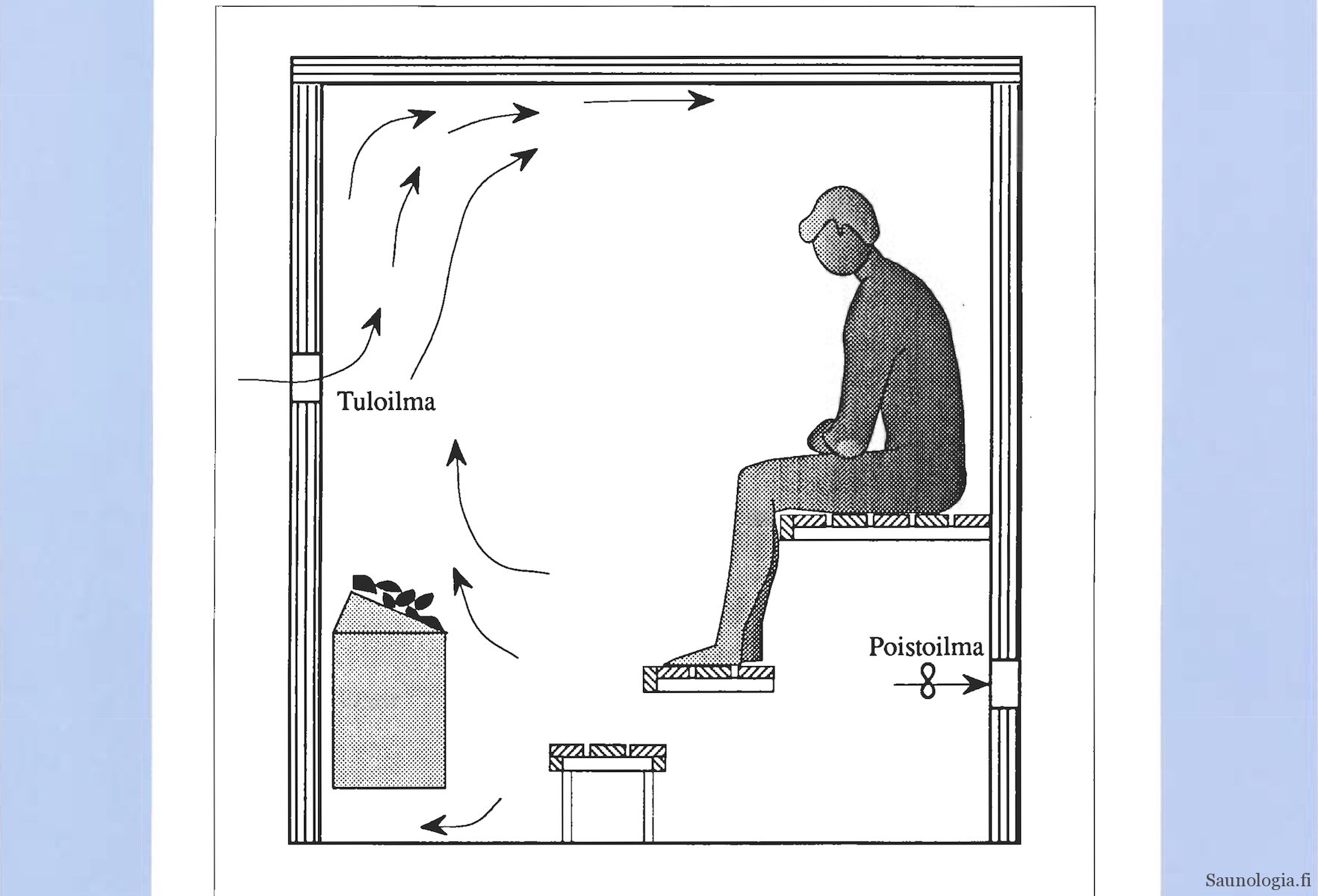
The recommended configuration for fresh and exhaust air ducts is quite straightforward. Fresh air should flow in above the stove, preferably not in the ceiling but closer to stove (e.g. 50 cm, or 2’). Return vent should be located below the level of the “feet bench”. Additionally, the sauna should be equipped with an exhaust vent in the ceiling that can be opened after sauna bathing to remove hot and damp air from the top of the room. This should be closed before heating up and using the sauna again. See the illustration below:

https://saunologia.fi/wp-content/uploads/2016/05/160513-Saunan_koneellinen_ilmanvaihto_VTT_raportti_kansikuva-small.jpg 

This should be quite simple to implement. The exhaust part may require a special solution. In Finland, a telescopic, aluminum “sauna duct” is often used behind the sauna paneling to extend the duct running above the ceiling to the level needed closer to the floor.

Mechanical sauna ventilation gets trickier to implement if your sauna room is too big to operate with a single vent (or so small that it tends to get drafty). Also if your mechanically ventilated sauna is running a wood-burning stove, things get complicated. Typical mechanical ventilation cannot provide an adequate air supply for the wood burning stove and a parallel, natural supply must be arranged one way or the other. 

I recommend that your mechanical ventilation should have an adjustable volume. This can be tricky with small houses that commonly have a single machine running the whole ventilation and air conditioning system. But if you can accommodate this wish, you should definitely do it. Adjustable ventilation provides flexibility to tune the system just so that the sauna and the settings feel the best. 

Solving the mixing problem selectively

There is a possibility of dealing with the mixing problem separately from the fresh air problem. A sauna concept known as the convection sauna in Finland does this, although very few Finns even know of about it. The convection, or air circulation sauna, operates by capturing hot air and löyly from the ceiling level to then blowing it back to the room on the floor level. This quickly equalizes temperature differences and provides a unique experience of löyly in your toes!

This solution has been developed to assist permanently disabled people to enjoy sauna, but a recent innovation from a company called Saunum makes it available also for the rest of the sauna loving people at a reasonable price. 


Garrett Conover: "Sauna Magic, Health & Happiness & Community

Garrett Conover: "Sauna Magic, Health & Happiness & Community

We recently sat down (virtually) with Garrett Conover and talked about his new sauna book. Here is our discussion transcribed. If you wish to buy your own copy, there is information at the bottom of the blog post.

What was the inspiration for Sauna Magic, and how does it differ from other books?

There are a couple of things that made me bold enough to embark on this project. One is the observation that although there are a number of books on sauna in English, few are entirely satisfying. The best are quite good, but always seemed to be missing something, and the worst are quite unrewarding both in content and quality of production.  I still find this curious, but thought I might somehow remedy this as both a photographer and writer.

In the introductory chapter I introduce the topic in a manner accessible and informative to newcomers, as well as appealing to the sensibilities of seasoned practitioners who may have more experience than me, and often, firm opinions on the topic. It also establishes the traditionalist approach I favor, and any open-mindedness I may possess. 

From there each chapter profiles a different sauna and its people, resulting in more nuanced diversity, broadening offerings beyond my preferences and sensibilities—which I confine to the chapter on my own sauna. These are stories about why we sauna as much as how we sauna. 

While I may mention such things as building and scientific/medical benefits, I make no attempt to duplicate what may be presented better elsewhere. Hopefully the subtitle: Health  Happiness  Community  conveys the story-form approach of the narrative and photography.

The photography is equal in importance to the text. What informed your approach to that?

This is complicated and I’ll try to be succinct. Before I was even aware that I was working on a potential book, I experimented with the camera gear in sauna context. To me, most sauna photography featured young, beautiful models inserted into un-fired saunas as backdrops. While well-composed, such images are mostly over-lit, overly-posed, and carry little bearing on the real essence of sauna. My first quest was for radiance and authenticity, so I made a self imposed rule that all interior shots would be made in real context, in full heat. The more I got away with pushing the equipment into temperature extremes, the more I knew I could eliminate fakery, and allow actual radiance to infuse the specifics of each shoot. 

My second self-imposed rule was to only shoot real sauna bathers in context, as their willingness to appear occurred. This approach guarantees diversity in age, physique, and human beauty, without imposition of ambient cultural tastes pushed by “youth and beauty” marketers and advertising myth-makers.

Overall it is very important to me to never violate the sanctity of sauna, and to be accepting and body-positive in all aspects of imagery.

Have you experienced any pushback regarding the presence of so many naked people in the photos?

Not yet. In fact, the responses have been keenly positive and accepting. One potential cover endorsement writer politely declined, being uncomfortable with the presence of mixed participants who were friends or strangers—and not immediate family to one another. I respect that, and don’t consider it a negative response. So far that is the only hint of push-back.

I was extremely careful with model releases, and observing modesty restrictions. All participants had veto power over images. And since the project was ten years in the making, I re-contacted everyone just before publication in case anyone wanted to revise their permissions.

Almost everyone willing to be interviewed and appear in images was remarkably open, placing few restrictions on the photography. 

The book designer was more conservative than I was. I had submitted the full range of options for all shots because I thought it important to “normalize” comfortable natural nakedness as it had been experienced by me as a journalist. She wisely talked me back a bit by noting that “Full nakedness is completely conveyed in the discrete images without diminishing anything. There is no reason to push anyone who might be surprised, offended, or angered by casual full depiction.”  I suspect I am more grateful than I know for that counsel.  

Non-electronic book publishing is becoming increasingly expensive. Any “sticker-shock” regarding the price of this work?

A little, but it tends to vanish once it is pointed out that the entire book is printed on photo quality paper and contains 166 full-color images.  The book is midpoint within the range of most coffee table offerings, and has far more text. I am most pleased with the outcome, and extremely gratified by feedback received, both from national and international buyers. 

Additional Information

Author: Garrett Conover, 2293 Elliottsville Rd. Willimantic, Maine 04443

Email: lutraonwilson@gmail.com

Phone: (207) 717-5146

Publisher: Maine Authors Publishing, 12 High St. Thomaston, Maine  04861

www.maineauthorspublishing.com

(207) 594-0091

Orders: Dan Karker Distribution Supervisor

orders@maineauthorspublishing.com

Combined book and shipping direct from Garrett:

Softcover                                                                    Hardcover

Media Mail US = $51.45                                            Media Mail US = $55.75

Priority US        = $54.30                                             Priority US        = $64.55

Canada              = $64.20                                             Canada              =$78.20

Overseas           =$70.95                                              Overseas           =$89.45

Orders through Garrett can of course be signed and inscribed. You may send a check, or use Pay Pal via:    PayPal.Me/SaunaMagicBook

Bookstores and other retailers should go through the publisher for wholesale rates.

Garrett also maintains a Facebook page:  Traditional Sauna

Spa Fleet Mobile Sauna Business

Spa Fleet Mobile Sauna Business

NASS recently sat down (virtually) with Henning Grentz. He started a business in 2018 that rents saunas in the Tri-State area (NY-NJ-CT) and parts of VT, MA and PA. Since this is a trend that is getting bigger, we plan on telling about these businesses at NASS’s website. The next one in the pipeline hails from Oklahoma!

1) Mobile Sauna business. Where did you get the idea?

The idea for a mobile sauna sprung from my life-long appreciation for Finnish style sauna and my realization that there weren't too many such saunas around the Hudson Valley. In fact, I noticed that there didn't seem to be much of a sauna culture at all, as far as I knew, in most parts of the United States. So, rather than establishing a local brick-and-mortar bath house, I thought that I could bring the joy of sauna to the relatively few sauna aficionados wherever they are in a much larger geographical area. Also, I hoped that the novelty factor would help spread the word about sauna culture and sauna's health benefits. Sauna brings joy and contentment, I believe.

For a few years leading up to the construction of the sauna, I have been sauna bathing in my friend Tom's basic but cute little sauna, which is located on a small island in the pond in his yard. Tom is a gentleman in his 70s who has Parkinson's disease, and I kept helping him out with fixing and maintaining the sauna, replacing a bridge to the island, and other projects. He's a real renaissance man, artist, and inventor, and he encouraged me right from the start as we were brainstorming trailer types, structural design, creature comfort features, and other design elements. 

2) Do you know/ where is your competition, either direct or indirect?

As they say, there's a fine line between genius and insanity. The jury is still out on which category a mobile sauna fits into, but if it is lunacy then at least I'm not the only lunatic. It hadn't even crossed my mind to look for other mobile saunas on the internet until mine was almost finished. In this country, they appear to be few and far in between. After Spa Fleet's launch, two separate parties, both located in Oregon, contacted me for feedback on construction, road rules, insurance, etc., and I was happy to help them out with some of the knowledge I had gathered. 

Within my delivery area, I only know of one other mobile sauna, down in New York City. However, I believe their core business is to host public sauna events in and around Brooklyn, whereas most of my customers by far, are private groups and individuals in small towns, the country side, or the suburbs. 

Otherwise, I suppose the larger hotels (e.g. Mohonk Mountain House in New Paltz, NY and the Emmerson Resort & Spa in Mount Tremper) have spas for their guests. I don't really consider those competition, though, as (a) their facilities are open to the public, and (b) the fact that my customers can choose wherever they want to sauna bathe is a very specialized feature.

3) How has the response been so far?

It has been great, especially this year as Spa Fleet is becoming more known. I have to admit, I am not terribly great at marketing, nor am I very interested in it, either. So, I do a little bit here and there, and let the word get out bit by bit. After all, this is a small business centered around relaxation, and if I ended up stressing out about trying to maximize profit or posting on social media all the time then this would likely sour the experience for me, and possibly for my customers, as well. So, I'm content to let the business grow organically and see where it goes.

So far, I am happy to report that I have had 100% enthusiastically positive feedback from my customers, and a few long-term (month+) and repeat bookings. I try to be flexible and accommodating regarding booking considerations (delivery times and such.) My customers appreciate how streamlined the process is for them, so they can focus on enjoying themselves.

4) Do most of your customers know how to sauna bathe?

I would say that about 30% of my customers are new to sauna or have little experience with it. When I say this, please bear in mind that mostly I communicate with the people who are processing the booking, so I cannot speak to the people in their parties (friends & family members, clients, co-workers etc.) I supply a user manual with the sauna, which, aside from the sauna's features, introduces safe sauna bathing practices. (You can find it as a .pdf at the bottom of www.spafleetrental.com/about for download.)

5) Final thoughts, anything you would need from NASS?

I just ordered a NASS membership. And I'd love to put a NASS plaque in my sauna, but the blue color would really clash with the color scheme. Is there any way I could purchase the design template from you?

Henning Grentz Spa Fleet - Mobile Sauna Rental 646.331.8329 www.spafleetrental.com

Discussion about sauna and health by our good friend, Bill Pupchek

Discussion about sauna and health by our good friend, Bill Pupchek

Bill lives in North Carolina and has been blessed with a good sauna at his local YMCA. He is a pilot instructor by trade and tries to go sauna bathing 3 - 5 times per week.

“Our sauna was recently rebuilt during a massive renovation of our YMCA and is better than ever, as far as public saunas go. Our sauna facilities are separated by sex and we have two saunas in each locker room, one at 165°F and the other at 190°F.  During the ISA Sauna Congress last year, there was a gentleman who had done a census of public saunas in the US, and based on the characteristics he was evaluating, the facility I use in Charlotte seemed to fall into the top 25% in the US even before the renovation, so we are quite lucky. I sauna because I love it! I like conversation with people when they're there, but I also enjoy the solitude when it's just "me, myself, and I" with a good book! I like to sweat 'cause it feels good and it MAKES me feel good!  😅

The topic of health benefits arises when interested -- but less informed -- friends or acquaintances assume the only real reason to go to sauna is to "melt off" pounds of fat. When I point out to them that this idea is largely fantasy, the next question is: "So why DO you sauna then?"

Social and communal explanations are looked on askance by the unknowing, especially in the USA where Americans still generally seem to believe that sauna bathing is some sort of excuse for naked old guys to meet up for surreptitious, unsavory sexual gratification of some sort.  This is when I launch into a list of all the health benefits I have experienced personally, objective benefits that further explain why I feel the need to sauna bathe three or four times a week even on 100° days in August in the Deep South.

The next question is: "So why do you have to be naked?" This too leads to health-related explanations in discussion of all the "creepy-crawlies" that grow in warm, moist textiles from body fluids and secretions, and how these distasteful sanitary concerns are much more in consideration of the others using the sauna facilities than they are of me, personally.  Naked is better for everyone, but, of course, you don’t “have to be naked”!

Transmission of COVID-19 to others is what led me to research the possible effects of sauna -- high temperatures and high humidity -- on the interpersonal spread of the virus. 

In the early days of the current hysteria, before the government actually shut down all gyms and health clubs, our local YMCA's first response to social-distancing concerns was, ironically, to close the very facilities that seemed LEAST likely to transmit COVID-19: the saunas and steam rooms! Yet they continued to maintain member access to sweat-stained weight machines & equipment, the slick plastic surfaces of the yoga & exercise studios, where the virus could live for days, and the locker rooms, where anyone was free to flail around their pollen and (potentially) virus-laden street clothing and footwear, within inches of each other.  This made no sense to me.

I ran across an article entitled “Can Sauna Kill Coronavirus?” on a website called Sauna Marketplace.  It made the case for high heat and humidity of the sauna as a viable means of reducing transmission of COVID-19, while also clearly acknowledging that sauna would do nothing to cure an infected individual exhibiting symptoms.

( https://saunamarketplace.com/can-sauna-kill-coronavirus )

Unfortunately, the news media picked up on the article, but missed the fine detail of "transmission vs cure", and misinterpreted the article as some sort of crackpot, Internet pseudo-cure for COVID-19.  They dismissed it out of hand rather than recognizing that heat and humidity at high enough levels -- as in a sauna bath -- could in fact kill the virus hanging around on hard surfaces, in textiles, and even on skin surfaces, as a credible means of mitigating the interpersonal spread of the virus. 

This idea was further supported by an academic paper published on March 9, 2020 by Wang, Tang, Feng and Lv, entitled “High Temperature and High Humidity Reduce the Transmission of COVID-19”, who accomplished a statistical analysis of actual viral transmission in 100 Chinese cities and found a significant correlation between the ambient environments and spread of the virus among residents.

( https://papers.ssrn.com/sol3/papers.cfm?abstract_id=3551767 )

I sauna just because I love to sauna! I had the best time in Tornio and Haaparanda last year at the ISA XVII International Sauna Congress and it had very little to do with any health issues! Sauna bathing DOES improve my health in many ways, but I am by no means a "health nut".  But I’m also not shy about citing specific health benefits of regular sauna bathing as a way of promoting sauna bathing to interested individuals who don't know they, too, would love it if only they gave it a try!

На здоров'я!  

("Na zdrovya!": it means "to your health!" in Ukrainian, my ancestral home where we “banya” whenever we can.)

Bill P

Sweat Culture: A Case for Inclusion by Bryon MacWilliams

Bryon MacWilliams is an American writer who was a foreign correspondent based in Moscow for nearly twelve years. He is author of the books, With Light Steam, and The Girl in the Haystack. His journalism, essays, poetry, and literary translations have appeared in publications big and small.

Sweat culture can get tribal. 

The Finnish sauna. The Russian banya. The Turkish hammam. The Japanese sento. The Korean jimjilbang. The Native American sweat lodge.

The architecture — the rituals — reflect the culture and personality of a people. 

The farther a bath culture spreads from its origins, though, the more it changes. And the more it changes, the more some try to preserve what was. The words “authentic” and “traditional” become code for what's better and worse, what’s right and wrong — not that, but this

But why take sides when so much unites us? 

All great baths make us healthier. All baths make us equal, humble, before the elements — air, fire, water. All baths make us feel not merely clean, but euphoric.

To me, each of the world’s great baths is a path to the same destination.

Besides, in sweat culture (like every culture), things aren't always what they seem. What we think is unique to one culture, sometimes, is not. 

Take the Finnish smoke sauna, or savusauna, the very root of sauna culture. As it happens the legendary bath is long rooted, too, in Russia, even carries a similar name — the black (chyornaya) or smoke (kurnaya) banya. 

Both baths are primitive steam rooms with primitive stoves, without chimneys.

Finns aren’t sure where the savusauna originated. Russians aren’t all that sure where the black banya originated, either. (The Russian Academy of Sciences traces the banya to the Baltic Sea region, to the northwestern territories between Lake Ilmen and the Western Dvina, or Daugava, River. Nearby, sauna cultures evolved — and endure — in Estonia, Finland and Lithuania.) 

Most Finns don't know this. Most Russians don't know this, either. 

Many are stout guardians of their respective sweat cultures — even though the baths at the core of each culture are, in fact, the same.

I love when history, and identity, are unclean — when fictions move narratives closer to true. 

I love, too, when connections drift, steam-like, across cultures.

Tribalism is antithetical to such connection; it's a different energy.

I'm grateful that the North American Sauna Society favors connection over separation, and has given me the opportunity to share with readers of its blog an excerpt from my book, With Light Steam, a memoir about Russia through the lens of its banya culture.

What follows is the beginning of the chapter during which I travel to Chuvashiya, an agrarian republic along the Volga River, to steam in the near-mythical granddaddy of the banya... 

and, as it happens, the sauna!  

— Bryon MacWilliams

Excerpt, The Banya is Life
Bryon MacWilliams

We would be resting between steams, our hair wet, our skin flushed, our backs slumped against benches, our chests rising and falling with a slow, pleasant fatigue from swings in temperature, hot to cold to hot to cold.

We would talk about our jobs, and our loves. We would talk about ourselves, too, when we were able to see ourselves as independent from work, or women. 

Sometimes we would talk about what we were feeling, not emotions so much as the physical sensations common to our chosen bathhouse in Moscow. Was the steam dry enough, soft enough, light enough? Were our senses aroused more, say, by the aroma of beer with reassuring overtones of mustard, or that of wormwood with slashing accents of peppermint?

Sometimes, when the steam was just right, we would not talk at all. Great steam, like great art, has the power to bring on quiet.

Such moments, for me, were a rejuvenating confluence of communion. With myself. With others. With the divine. Every so often, though, these spells of good feeling would be broken by declarations from other bathers, always Russian, that what we were experiencing, in fact, was not special.

“You call this a banya? This isn’t a banya, this isn’t a banya. There is only one true banya, one true Russian banya — the black banya!” 

“The steam here is good. I won’t dispute that, I won’t. But you’ll never know what steam truly is until you’ve steamed in a real Russian banya, till you’ve steamed black-style!”

Most of it was hearsay, I knew. More Russians have seen the yeti than have steamed in a black banya. 

Black banyas are nearly extinct. They just barely exist. They are the truest link to the ancient Slavic steam baths of another millennium.

Black banyas are black because they do not have chimneys. Literally, they are black: the ceiling and interior walls are caked with soot, from smoke. 

I have never appreciated being ripped out of a moment by someone telling me that there was a better moment, elsewhere to be had. Over time, though, the remarks of other bathers caused the vision in my mind of a dingy, soot-encrusted black banya to shimmer with the enchanting sheen of myth. Over time, I came to regard my appreciation for the Russian cult of steam a bit like Cicero regarded his history: “Not to know what happened before one was born is always to be a child.” 

Knowledge and awareness are not peers of experience; like the dismissive remarks of the other bathers, they are only so much hearsay. 

I decided to find a black banya, and to steam in it.


The XVII International Sauna Congress is starting 07.06.

The XVII International Sauna Congress is starting 07.06.

PRESS RELEASE  28.05.2018

The International Sauna Association ISA   is organizing the International Sauna Congresses every four years in different parts of the world in the countries where there are member associations.

This XVII  rights were  given after a tight competition between China and Sweden finally to Swedish Bastuakademie.

The organizing  group headed by the Chairman of Bastuakademie Mr. Göran Honkamaa started its work about a year ago. Just now we are in a situation where we can see that the work has been succesfull and we have an outstanding program. 

Besides Honkamaa the important part of the work has been done by Hans Hägglund, Svante Spolander and Roger Häggström with Bastuakademie.

ISA  and ISA President Risto Elomaa has also been part of the organizing group controlling that  everything is done according to the bylaws of ISA as well as the traditional practices.

Over 200 people from about 24 countries have a full program starting on Thursday  07.06.2018  with an exciting full day smoke sauna tour to Soukolojärvi.

Before the opening Get to Gether event, ISA is also having its Board and General meetings deciding e.g. the Board etc. for the next term of four years starting 2019.

The get together event is a meet and greet for all those delegates that have come to the premises with an option to taste some local food and  beer in the old Lapin Kulta brewery, Lappari which is today an important place for big events in Tornio.

On Friday the day is full of presentations in three different sessions in Park hotel Tornio. The full program is available on the  page http://www.bastuakademien.se/nationalbastudag/xvii-sauna-congress-2018-35861132

At the evening party grill food is served with the option to try several saunas at Kukkolaforsen. The event is important especially for Bastuakademie, because they have their 30 Year Anniversary. This means naturally that all the saunas in Kukkola are in full use also after the party. The estimate is that there are around 18 saunas available. 

On Saturday the day is further full of presentations and workshops. After these an important meeting of international journal of Sauna Studies IJSS will take place. The idea is to restart publishing sauna research and related papers in a journal like ISA and German Saunabund were  doing for many years in the form of International Sauna Archive. Our friends in Australia have been doing a lot of basic work for this and we hope that in the meeting we can find a group that is willing to go further.

After the official program there is again a party at Kukkolaforsen where this time the International Sauna Association is having its 60 Years Anniversary. After the three course dinner prepared and served in this famous restaurant, there is also music and other program.

All the 18  saunas will be open as long as there is interest in using them. Actually the slogan Midnight Sun Sauna means that we use them until morning. This time of the year we have Midnight Sun in that region, as well.

Once again ISA has succeeded in getting some of the key speakers in the sauna world  to present the latest material about many aspects of sauna and sauna culture. Such names as Jari Laukkanen, Mikkel Aaland, Lasse Viinikka, Mark Timmerman are on the list. We are sure that the presentations give many new aspects for the sauna and how to use it. The presentations cover the globe from Sydney to Seattle like the delegates. And as delegates we also see people from Pakistan and Kenya, which are not traditional sauna countries.

Japan delegation is a group of 20 people. Two of whom are also having presentations on Japanese sauna and sauna culture; The Japanese Sauna Ambassador Katsuki Tanaka as well as sauna entusiast and photographer Miki Tokairin both have been publishing books and articles about various sauna.

We introduce the delegates some aspects of the Interbad exhibition which is happening in 2018 in Stuttgart.

TyloHelo is talking about the history of sauna and especially sauna stoves when having their 100 Years Anniversary in 2018.

Saturday is the SAUNA DAY in Sweden as well as in several other countries. This is celebrated by announcing the SAUNA PEACE in several languages.

We have also succeeded in getting a group of whisking specialist from Lithuania to show their skills as well as give some oral presentations about whisking generally. This group, headed by Rimas Kavaliauskas, is there at Kukkolaforsen on Saturday afternoon and also on Sunday morning.

Another interesting group with their own mobile Banya, headed by Egor Andrejev, is showing also whisking and other treatments as well as giving oral presentations about banya culture also on Saturday afternoon in Kukkolaforsen. This is something we are really waiting for.

On top of all this, participants have a chance to participate in some of the sauna tours organized  specifically for the delegates. Even fishing in the Tornio river is possible and the timing should be perfect for salmon migration. The host of Kukkolaforsen, Svante Spolander, with his group knows everything about fishing and nature, further his wife will be making sure that the restaurant there is having excellent  and absolutely fresh local food available all the time.

One special aspect for many foreigners is the fact that the Congress is happening in two different countries and you will be crossing the boarder several times when moving from the hotel to congress and further to Kukkolaforsen. Tornio river has been the boarder between Finland and Sweden for over 200 years but the saunas are similar on both sides and there is even one common language still spoken. 

We hope that the visitors can bring some of that  sauna culture and nice experiences with them back when going home.

28.05.2018

Risto Elomaa

The International Sauna Assoaciation      E-mail: sauna@kolumbus.fi

Vaskiniementie 10 , FIN-00200 Helsinki   www.saunainternational.net

Design of Auxiliary Spaces in a Sauna by Lassi a. Liikkanen

Design of Auxiliary Spaces in a Sauna by Lassi a. Liikkanen

(Link to the original post at the end of article)

During serious sauna bathing, the majority of time is spent outside the actual hot sauna room. However modest your sauna may be, you have to take into account in its design phase how to get hot water, where the bathroom is going to be, and where your clothes and towels can be neatly stored.  This article works as a reminder for the auxiliary space requirements for the sauna. It introduces models for a modest and a luxury version of sauna structures as typically found in Finland.

As I’ve been creating Saunologia.fi for over two years, I have written a number of articles contemplating the sauna experience from many different angles. For the most part I have devoted writing about the hot sauna room and perfecting it in the Finnish style.

Recently I have realized that the hot sauna room is only an ingredient, albeit the most important ingredient, in a wholesome sauna bathing experience. At least a typical Finn is spending at least as much time outside the hot room as s/he is spending inside one.

171013-kaurila-sauna-yleiskuva-lauteilta-1600x1000.jpg


Wood-fired stove  inside the Kaurilan sauna hot room

So this article looks beyond the heart of sauna, or to be exact, the room which Finns also call “löylyhuone” or steam room. However,

the word steam room is frequently used outside Finland to refer to totally different types of baths so this story uses the term hot room to refer to the heart of the sauna building or facility.

Other space needs

 Besides the sauna hot room, auxiliary spaces have to be designed carefully in order to guarantee a satisfactory sauna bathing experience. These spaces can include:

  • Shower room
  • Dressing room
  • Bathroom
  • Cleaning closet
  • Patio
  • Swimming pool
  • Den with a fireplace
  • Restaurant (at a public sauna)
  • Foyer (at a public sauna)
  • Log closet
  • Technical closet/ furnace room

At a public sauna establishment there can naturally be many saunas, dressing rooms and bathrooms. At Saunologia, I have chosen a residential point of view, so I will next introduce two versions of saunas, a modest sauna individual use outback and a more luxurious sauna for both individual use and socializing.

180411-sauna-spaces-functional-connectedness-v3-2.png


Connections between the auxiliary spaces or functions of Finnish saunas: a simple sauna cabin and a luxurious one

A note about the terminology in the picture: the simple cabin has no running water, so it has a separate outhouse for toilet needs. The luxury sauna facility resembles a modern detached house in all of its functions.

The Hot Room vs. Auxiliary Space Needs

There is a rule of thumb according to which the shower room must be 1.5 times bigger than the sauna room and the dressing/ locker room should be twice as big as the sauna room.

Suggested relative sizes of the spaces inside the sauna building:

180411-sauna-spaces-relative-sizing-2.png


Space needs for distinct rooms of a Finnish sauna

The calculation of the room sizes starts with the hot room. It should be designed considering how many people will be using the sauna at once. In Finland, tiny apartment saunas may only accommodate 2 people, but most private saunas can seat 4 to 6 people at a time. 50 sq ft is barely enough for that.

The logic of sizing the other rooms is based on keeping them spacious. It is expected that people flow through the rooms at different paces. This means that your design may start from a four person hot room, but have three more people in the shower or dressing room, who eventually crash in the dressing room at once. Having enough space for all supports relaxation and feeling at ease in the sauna.

170831-tykkimaen-sauna-pukuhuonesuihkut-1600x900-2.jpg


Spacious dressing rooms at Tykkimäki public sauna in Kouvola, Finland

You will also need cleaning closet, trash bins, water and clothes hooks

 A public sauna requires professional cleaning and maintenance. Cleanliness is one of the core elements in a Finnish sauna. Even  a personal sauna should have a cleaning closet, where the sauna’s cleaning supplies are held. It doesn’t have to be big as long as it keep things neat and tidy, preventing  equipment laying around in the sauna. Naturally you also need a trash bin for empty bottles, caps and other trash.

Lockers are the tidiest alternative for organizing the dressing room, but might feel strange in a private sauna space. Regardless, there need to be enough hooks and shelves for all sauna bathers.

170723-Suvikallio-Terassi-naulakko_0160-1600x1067.jpg


Makeshift clothes hooks at my Suvikallio sauna

Warm water is needed in a Finnish style sauna. A rule of thumb is that you need 2.5 gallons of hot water per sauna bather, which gives you around 5-7 gallons of warm water for people to wash themselves. If only quick showers are needed, water consumption is less. Most saunas in Finland have a separate room for washing, which allows to use a shower stall for instance. Washing up inside the hot room is possible if you allocate enough space (10 sq ft or more) and have enough vertical space so the temperature at the floor level can be kept moderate.

Finally, don’t forget the bathroom. To be self sufficient many Finnish cottage saunas include an outhouse. In an urban environment, you will have something more modern, but you must definitely have it! (not to say that Finns would consume much sauna beers)

To sum things up, let’s create a check list of what could be needed to set up a working sauna establishment. Things like a mirror and a trash bin are important to remember, also one could have a dedicated shelf for eyeglasses as the Germans do.

Washing area:

  • Benches
  • Shower seats
  • Shelves/ lockers
  • Towel hooks
  • Shampoo holders
  • Soap dispensers
  • Guideposts (if commercial)

Dressing room:

  • Benches
  • Tables
  • Clothing hooks
  • Dress lockers
  • Shelves
  • Mirror
  • Dryer
  • Trash bin
  • Hamper
  • Guideposts (if commercial)

This post first appeared at www.saunologia.fi https://saunologia.fi/design-of-auxiliary-spaces-for-a-finnish-sauna/

Sauna Trip to Finland and Sweden

I had the privilege of traveling to Finland and Sweden from September 19th to 30th. What made this trip interesting were the opportunities to sauna bathe.


After a couple days in Helsinki, Finland, my wife and I took a ferry, the Silja Serenade, over to Stockholm, Sweden. We were happy to bump into some old friends from both New York and Helsinki. Instead of sharing a table at one of the nice restaurants on board, we had arrangements to spend some time in the ship's spa section. Luckily for us, this is the start of the off-peak season and most people on the ship were dining, so the spa was not too crowded during our visit.


There are separate saunas for ladies and gentlemen, and in addition at least one or two private saunas that can be reserved beforehand on the shipping company's website. So off we took to the spa an hour after the ship sailed. We were greeted by very nice waitresses at the entrance and were escorted to a surprisingly spacious private dressing room with couches, etc. The sauna could easily accommodate a half dozen guests so there was plenty of room for the two of us. An added bonus was that we were served drinks and finger food directly to our private quarters, and it was not overly costly, either. The common section of the spa consists of three large jacuzzis, a steam room, and a bar. Because of the early hour of our visit we were able to have one of the jacuzzis to ourselves. What a beautiful way to spend time it was to watch the archipelago sunset in the bubbly water through floor to ceiling windows while feeling elevated and relaxed by the sauna. We were two truly happy campers. It was not a party cruise, though, jetlagged and after two hours of sauna bathing we went to sleep in our nice cabin around 9PM. Have to say, though, that the next day couldn't have been better. Unfortunately we didn't have time to take the ferry back, but had to fly to Helsinki due to a previous engagement.


The following Saturday we drove to central Finland to visit relatives and were able to fire up a very old smoke sauna twice. This sauna has been there since the 18th century. Again around 2 hours of sauna bathing each time, but this time we were sissies; no plunging into the river since the water was already a fresh 52F. You have to know what you are doing when you heat up a smoke sauna, because if you don't follow the ancient protocol, there is a chance that you will end up with carbon monoxide poisoning. However, since basically the whole humankind has been doing this for thousands of years, apparently deep down the heating process is manageable. That smoky smell on your skin afterwards is just so soothing and nice. In this busy world one can yet question the habit of heating the sauna for five hours straight and then enjoying it for only around a couple. But like in sailing, the preparation is part of the enjoyment.


The day before we left back to New York, we were also lucky enough to visit the new "Loyly" high-end sauna/restaurant establishment in downtown Helsinki, which seems to be super popular. We arrived there early, at lunchtime, and it was hard to get a table, let alone get tickets to the sauna. We started our sauna when the sauna section opened at 1PM and when we left the premises around 3PM it was already sold out for the day. However, this was Friday after all and it was refreshing to see some corporate people spending time there together, men and women. Not a problem in that part of the world and it is important to point out that bathing suits were mandatory. So like at the beach, people were sitting together, this time however by the fire with a glass of champagne in their hands.


I also met the guy who runs the sauna section. It consists of one traditional sauna that seats perhaps 25-30 people and one smoke sauna that seats 15-20. I wish I had had this conversation with him before entering the saunas. There is a hatch on both heaters that should be kept open just right. You leave the hatch open for too long and the saunas become too hot and dry, you keep them closed and the saunas are humid but lack a little bit on the heat side. This time we did dip into the sea, me once, wife twice. Apparently there is a vast difference since now the water was 55F!


All in all I wish the high-end sauna culture would start spreading more in the US as well. Here in New York, it is mostly ethnic Russian traditions that drive this type of thermal therapy. You can always of course build a sauna in your own house; then it is as high-end as you want it to be.

Eero Kilpi

PhD

President of the North American Sauna Society

Silja Line

Loyly Helsinki


Health Benefits of Sauna By Mark Timmermann

Introduction

The use of heat while bathing has been an integral part of many cultures for centuries. Finland is well known as a society of avid users of the sauna, which usually produces a relatively dry heat between 70 – 100 degrees Celsius. The traditional Finnish sauna is a smoke sauna (“savusauna”) where stones are heated with a fire for several hours and then the sauna is taken after much of the smoke has cleared from the sauna building. More commonly today, saunas are heated by stoves using wood or electricity, and water is used intermittently on the stones to produce steam.

Other cultures known for their heat bathing traditions include Russia (Banya), Lithuania (Pirtis), Sweden (Bastu), and Turkey (Hammam). Here in the United States, the American Indians traditionally have used sweat lodges for spiritual ceremony. The rest of American sauna culture has been influenced by European immigration during the late 1800’s and early 1900’s. In my own case, for instance, I grew up in a northern Minnesotan town where many Finns immigrated in order to work in iron ore mines. Many of us therefore had saunas in our basements or at our lake cabins.

Sauna bathing usually involves several repetitions of alternating heat with cold, such as 15-20 minute heat exposures interrupted by dipping in a pond, taking a cool shower, or sitting outside. In some cultures, oak or birch twigs and leaves and/or steam are used to provide a more intense heating and massaging experience.

Health Benefits

There are many myths regarding the physiological and psychological affects of sauna bathing. Unfortunately, we lack sufficient large, controlled studies in the medical literature to help fully understand the science supporting these myths. We have learned a significant amount about the physiologic adaptations of the body to heat bathing, however, and there is a growing body of scientific study, especially from Germany and Finland, to help understand the real benefits and risks of the practice.

Physiologic Response

Essentially, the effects of heat bathing are the body’s way to deal with heat stress. In other words, heat exposure causes a person’s physiology to react to that form of stress out of self-defense in order to prevent injury. The systemic adaptations that occur over time can indeed make a person stronger, similar to adaptations to regular exercise.

Initially, as the body is exposed to the heat of a sauna, the skin temperature increases. As a way to dissipate the heat and protect the internal organs, the body decreases blood flow to those organs and increases circulation to the skin. In addition, sweat glands are stimulated in order to allow for evaporation and further cooling effect.

Because the blood volume to the periphery and skin is increased, the heart rate must also increase so that the internal blood pressure can be maintained. While the overall work of the heart does not change significantly, the pulse can increase up to double the normal rate.

Breathing becomes more rapid and shallow in the sauna, and the overall flow rate and lung capacity increases, suggesting more efficient pulmonary ventilation and allowing for additional heat dissipation.

The sympathetic nervous system is also stimulated as skin temperature rises, causing a “flight or fight” response. Stimulation of the hypothalamus and pituitary glands in the brain, which communicate with the adrenal glands near the kidneys, causes release of cortisol (“adrenaline”), creating a heightened sense of alertness, reduced perception of pain, and elevated mood. Interestingly, when a sauna is followed by a plunge into cold water, this adrenaline response is elevated even more.

Cardiovascular Benefits

There is good scientific data to support the beneficial effects of repeated sauna exposure for the heart. In particular, a person’s resting systolic blood pressure can decrease as much as 10 points after just three 20 minute sauna sessions several days apart. Some studies have found up to a 20-point systolic blood pressure decrease with regular sauna exposure (such as twice per week) over a several month period.

Congestive heart failure, which is related to poor pump function of the heart, has also been shown to benefit from regular sauna exposure. Both symptoms and heart rhythm abnormalities improve predictably with regular sauna use.

Importantly, because the workload on the heart is generally not increased in the sauna, the risk of myocardial infarction (“heart attack”) in the general population is not higher during sauna bathing. While it is usually recommended that a person who has had a cardiac event or procedure should wait at least 6 weeks before going back to sauna bathing, it is considered to be safe practice for people with heart disease.

Training Effect

Because many of the body’s adaptations to sauna are similar to its response to exercise, many people wonder if taking a sauna can improve cardiovascular fitness. While one recent study has suggested that endurance performance does improve for runners who recover in the sauna after training, in general one’s fitness does not improve with routine sauna bathing alone.

With regular sauna bathing, however, the body does adapt to heat stress, so that one can tolerate longer and hotter sauna exposures without injury. People who are new to saunas are therefore encouraged to moderate their heat exposure by limiting their time in the sauna, or by sitting on a lower bench. In addition, athletes who use the sauna routinely are able to exercise more efficiently and perform better in warm temperatures.

Respiratory Benefits

Part of the sympathetic nervous system response also relaxes smooth muscle in the bronchioles of the lungs, allowing for more efficient respiratory function. Patients with both asthma and chronic obstructive pulmonary disease generally report improved symptoms and ease of breathing while in the sauna, although longer-term studies have not generally shown an overall improvement in lung function with regular sauna use.

Musculoskeletal Benefits

During a sauna, joint synovial fluid becomes less viscous, allowing for improved joint mobility, and skeletal muscle is relaxed. These changes, along with the increased pain tolerance that one experiences, provide for a significant subjective decrease in musculoskeletal pain. Interestingly, for patients with rheumatoid arthritis and other autoimmune disorders, pain and inflammation have found to be increased on the day after taking a sauna – unless the sauna bath is followed by a cold immersion. For patients with arthritis that use cold-water bathing after sauna, there can be an overall improvement in symptoms.

Immune System

There are some studies that support the notion that regular sauna use stimulates the immune system. During a sauna session, white blood cells increase in the bloodstream, suggesting an elevation of the body’s natural defense against illness. With routine sauna practice, at least one study has shown a decrease in the incidence of the common cold.

Psychological Benefits

One of the most common reactions to taking a sauna is that it simply seems to make people feel better. As it turns out, there are some measurable scientific reasons behind that.

Sauna exposure causes a significant release of Dopamine, a neurotransmitter, and Beta-Endorphin, a neuropeptide hormone. These substances cause a sense of euphoria, as well as improved mood, energy, sense of calm, and pain tolerance. (Endorphin is a combination of the words “ENDOgenous”, or occurring naturally in the body, and “moRPHINe”, a pain-relieving compound). The level of endorphins released during sauna bathing can be three times normal, similar to a middle distance training run. This “runners’ high” that occurs can be somewhat addictive and may affect regular sauna users in the same way it affects regular exercisers.

Sleep is also improved after a sauna, with some research showing longer stage 4 sleep, which provides a deeper, more restful sleep and healthier dream activity. Sleep affects so many other aspects of health, including mood, immune function, and ability to handle stress, that this alone would seem to suggest a significant health benefit from regular sauna use.

The psychosocial aspects of group activity such as sauna bathing may also be an important part of the health benefits of sauna. Social connection, sharing with friends and feeling a part of a community, as well as the personal nature of conversation that is fostered in the sauna, all play parts in the cultural validity of group sweating that has existed in so many cultures over time. In addition, for those cultures that promote nudity in the sauna, a sense of equality and openness exists that one does not normally experience in every day life.

Risks

While quite safe if done in moderation, sauna bathing can present health risks.

Because the body uses sweat to help regulate core temperature during a sauna, dehydration can be a problem with excessive sauna use. Some athletes, such as wrestlers, have used the sauna for rapid weight loss through loss of water through sweat, and this has occasionally led to heat stroke and sudden cardiac death. When combined with the misuse of diuretic pills, this practice can be especially dangerous.

Alcohol consumption creates many potential risks for the sauna user. Alcohol counteracts the anti-diuretic hormone that the body normally secretes during heat stress in order to help the kidneys retain fluid. In addition, alcohol causes the peripheral blood vessels to become even more dilated than usual in the sauna, which can lead to rapid fall in blood pressure and cause falls or fainting. Alcohol also excites cardiac muscle and reduces coronary artery flow, increasing the risk of both arrhythmia and myocardial infarction.

Cold-water immersion is a common practice following sessions in the sauna. This causes rapid constriction of the skin blood vessels, which causes blood pressure to increase (as opposed to in the sauna where it remains stable). There is also a significant stimulation of the sympathetic nervous system, with rapid increase in adrenaline, heart rate, and also endorphins. Hence, the sense of euphoria and well being that one experiences following cold immersion intensifies that from taking a sauna alone.

Data is mixed regarding the benefit of cold immersion for muscular tissue following exercise, but there are several studies that support improved blood flow and more rapid recovery of muscular damage and soreness with cold immersion. As mentioned above, those with inflammatory conditions like rheumatoid arthritis demonstrate benefit with cold water immersion following sauna bathing.

Of concern however, is the fact that cold immersion can lead to cardiac arrhythmia and coronary artery spasm, making it potentially dangerous to those with heart disease. There are cold receptors in the face and scalp that respond to a rapid fall in temperature. This stimulates the “diving reflex”, which is a complex cardio respiratory reaction that causes apnea and a sense of shortness of breath, decreased cardiac output, and rapid decrease in pulse. Heart arrhythmias are common during this response, and can pose a danger to those prone to dangerous heart rhythms or at risk for heart attack.

As we can see, while people with heart disease can generally use the sauna safely, this is a population that should absolutely avoid alcohol before and during sauna bathing. In addition, these individuals should take extra caution when plunging in cold water to avoid exposing the face and head. A cool shower or slower cooling simply by sitting outside is generally considered safer practice for this group.

Conclusion

Sauna bathing causes the body undergo many physiologic changes in attempt to protect itself against heat stress. Some of those adaptations can provide health benefit, most notably to resting blood pressure. There also evidence to suggest improved function in other aspects of cardiac, respiratory, musculoskeletal, and immune function. Regular sauna use increases the ability for athletes to train or perform in heat, and post exercise saunas may improve endurance. Many of the benefits of sauna bathing are psychological, including improved sleep, mood, and pain tolerance. Cold plunging following a sauna can accentuate some of these benefits, but caution is advised regarding immersion of the face and head. Alcohol use before and during the sauna is also ill advised, as is the practice of using the sauna for rapid weight loss. Otherwise, sauna bathing is considered very safe and regular use can benefit overall physical and mental health.

(Dr. Mark Timmerman is a Family Physician and Sports Medicine Specialist in Wisconsin, USA. He has a wood heated sauna in his home and takes a sauna at least three times each week).